The Discussion Behaviour card sits under the seats. Its four controls follow your account, so the Mac, the web and your iPhone show the same values.
Where to find it. Mac: Settings → The room → Who's In The Room → Discussion Behaviour. Web: Settings → Who's In The Room → Discussion Behaviour. iPhone: Settings → The Room → Who's In The Room → Discussion Behaviour.
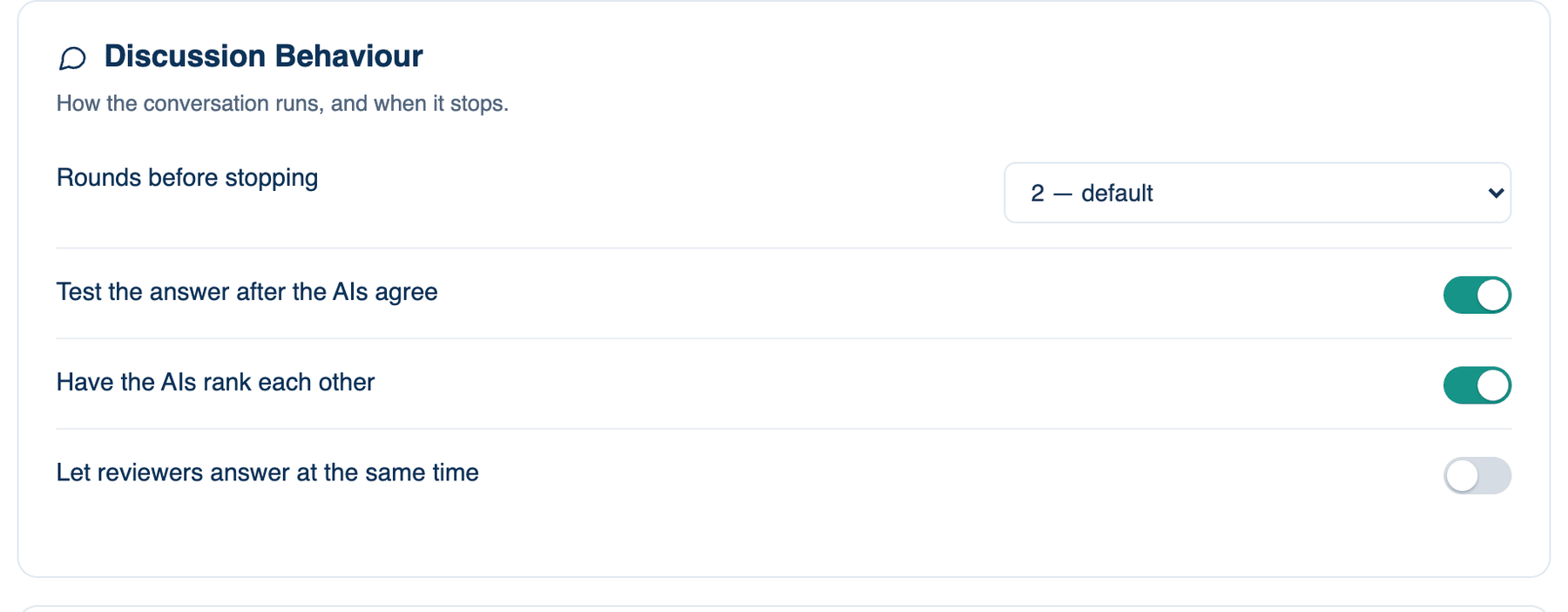
Rounds before stopping
A round is the lead working, then every reviewer replying. The room stops early the moment everyone agrees, so the number is a ceiling. Choices: 1 — no review pass, a fixed number from 2 upwards (the default is 2), and Until they agree, where money is the brake. Your plan caps the number: 3 on Free, 6 on Pro and Team.
How to use it. Pick a number. If you pick Until they agree with no session cost ceiling set, a line appears asking where to stop the session, prefilled with ten dollars; Set & switch saves both.
When to use it. One round for quick answers you will check yourself. Until they agree for a hard question where you care more about the result than the bill.
When not to use it. Every round re-sends the whole discussion, so cost grows faster than the count. Until they agree also hard-stops at 25 rounds, and a reviewer raising something new three rounds running ends it early.
Further reading. ReConcile: Round-Table Conference Improves Reasoning via Consensus among Diverse LLMs — Chen, Saha, Bansal, 2023.
Test the answer after the AIs agree
After agreement, the app runs this project's tests once more on the final code. It uses only tests that have caught a real mistake here before. A failure marks the discussion "not verified".
What changes. On (default): no AI cost, a little time; tests over 30 seconds are skipped, and nothing runs if no files changed. Off: agreement is the last word. It takes effect on the Mac, where the tests are.
Have the AIs rank each other
After everyone has answered, each AI puts the other answers in order, best first, and the result appears in the discussion's Summary.
What changes. On (default): the AIs see each other only as Model A, B and C, and never their own answer, so there is nothing to favour. You always see real names. A message you address with @ is never anonymous. It costs one short extra question per AI. Off: no ranking, and the AIs see real names.
Further reading. Large Language Models are not Fair Evaluators, Wang et al., 2023; LLM Evaluators Recognize and Favor Their Own Generations, Panickssery, Bowman, Feng, 2024.
Let reviewers answer at the same time
What changes. Off (default): reviewers answer in turn, each reading the others first, so one can check what another skipped. On: they answer together when the lead changed no file, which can halve the wait. You lose the division of labour, since two may check the same claim and nobody the third. You gain independence: answering in turn, later reviewers tend to agree with the first objection. A turn where the lead built something is always reviewed in turn. It takes effect on the Mac; the web and iPhone always answer in turn.